For years, the luxury sector maintained a dignified distance from social commerce. There was an industry-wide hesitation to mix a prestige purchase experience with the rapid, often chaotic energy of in-feed shopping. But the gravity of TikTok’s commerce ecosystem—TikTok Shop—is no longer ignorable.
We are seeing a strategic tipping point. According to data from WWD, legacy houses are beginning to test the waters, moving beyond mere awareness campaigns toward in-app conversion. However, for a global luxury brand, launching on TikTok Shop isn’t as simple as turning on a “Buy Now” button. It introduces significant operational paradoxes that, if not navigated correctly, can erode brand equity. Let’s dive into main roadblocks an strategies to implement TikTok Shop for Luxury Brands.
The Operational Headache: One Page, One Country
The biggest operational barrier for global luxury brands is TikTok Shop‘s foundational structure: it requires a localized strategy. Currently, the platform model forces a brand to have a dedicated, localized TikTok page to operate a shop in a specific market (e.g., BrandName_UK for the UK shop, BrandName_US for the US shop).
For a global luxury house that has spent a decade consolidating its online presence into one pristine, unified global handle (e.g., @BrandName), this presents a nightmare. The dilemma is clear: Do you fracture your global community and dilute your brand identity by creating dozens of local sub-handles? Or do you ignore TikTok Shop in key markets and risk losing the commerce race entirely?
For global brands built on exclusivity and consistency, the idea of maintaining individual, high-quality local content strategies is often a resource hurdle not worth jumping.
The solution here would be to ensure that the localization of your global account is set to the US if you plan to launch TikTok Shop in that market—which I understand is not an easy conversation to have.
1. The Strategy: Prestige-First Commerce
The core conflict for luxury brands on TikTok is the tension between “shoppable entertainment” and “aspirational distance.” To succeed, the implementation must shift from a traditional high-volume discount model to a discovery-led boutique model.
Instead of using TikTok Shop as a clearance outlet, luxury brands should treat it as a digital flagship for specific, high-velocity categories like leather goods, eyewear, or fragrance.
Key Operational Rules:
Price Integrity: Never use “Flash Sales” or countdown timers. Maintain MSRP (Manufacturer’s Suggested Retail Price) to protect brand value.
Gated Access: Consider using “Invite-only” or “Drop” mechanics to maintain a sense of exclusivity.
The Unified Handle Problem: For global brands, TikTok requires a local “Seller Center” for each region. You must decide between a Centralized Global Page (high brand equity, no direct shop link) or Regional Shop Pages (direct conversion, higher management overhead).
2. Implementation: The Three-Pillar Model
To maintain luxury standards, the implementation should rely on three specific pillars of the TikTok ecosystem:
Pillar I: The Targeted Affiliate Plan
Unlike the “Open Network” where any creator can link a product, luxury brands should utilize the Targeted Plan. This allows the brand to hand-pick specific creators whose aesthetic aligns with the house. You send “Collaboration Invites” only to vetted influencers, ensuring the content surrounding the product remains elevated.
Pillar II: Live Shopping as Concierge
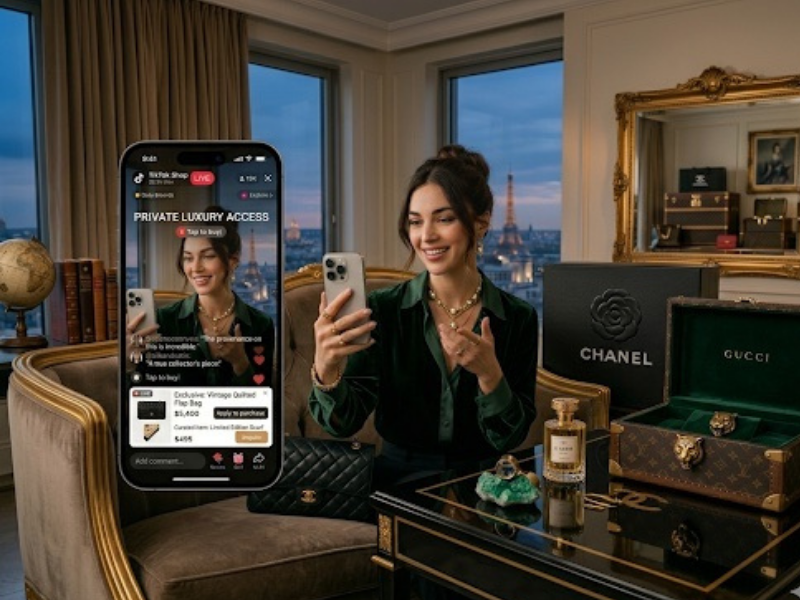
Luxury Live Shopping should look less like a telemarketing segment and more like a private concierge session. High production value, neutral backgrounds, and expert “storytellers” (rather than loud presenters) are essential.
Pillar III: Paid Media Amplification (Spark Ads)
Organic reach is the foundation, but Spark Ads are the accelerator. By boosting high-performing creator content rather than traditional brand ads, the commerce experience feels native and authentic to the user’s feed.
3. Proposed Action Plan (The “PNA”)
A successful launch requires a structured Phased Narrative Approach (PNA) to ensure the algorithm and the audience are primed before heavy investment.
Phase 1: The Content Seed (Weeks 1–4)
Objective: Build social proof and search volume.
Action: Partner with 30–50 “Targeted Plan” creators to produce high-quality organic content (unboxing, styling, “get ready with me”).
Goal: Reach a minimum of 50 unique pieces of content live in the ecosystem.
Phase 2: The Validation Threshold (Weeks 5–8)
Objective: Quantitative proof of concept.
Action: Monitor organic sales. Many brands set a Mandatory Revenue Threshold (e.g., $10,000 in organic revenue) before unlocking media spend.
Rule: No paid “boosting” is allowed until the product has been validated by the community’s organic interest.
Phase 3: The Scaling Phase (Weeks 9+)
Objective: Maximize conversion.
Action: Deploy Spark Ads behind the top 5% of performing creator videos.
Optimization: Shift budget toward the creators driving the highest “Add to Cart” rates, while maintaining a 70/30 split between awareness and conversion content.
4. The Long-Term Outlook: Fees & Sustainability
While TikTok Shop offers a direct path to the Gen Z and Alpha consumer, it comes with a “Prestige Tax.” Brands must account for:
Platform Referral Fees: Typically a percentage of each sale.
Logistics (Fulfillment by TikTok): The cost of ensuring the packaging and unboxing experience meets luxury standards, even when handled by third-party logistics.
Affiliate Commissions: Higher rates (15%+) are often required to attract top-tier “prestige” creators.
In the long term, TikTok Shop should be viewed as an entry-point tactic—capturing the customer where they spend their time and moving them into the brand’s broader CRM ecosystem. TikTok Shop for luxury brands is definitely a new frontier of shopping that should be tested.
Final Ideas for TikTok Shop for Luxury Brands
For a luxury brand, Gated Access on TikTok Shop functions similarly to a “Digital Velvet Rope.” Instead of having your entire catalog available to everyone at all times, you create artificial scarcity to drive urgency and maintain prestige.
Three examples of implementation:
The “Password-Protected” Collection: Partner with a top-tier influencer to reveal a “secret code” during a Live stream. Customers must enter the code on the product page to unlock the ability to purchase.
The “Live-Only” Drop: Announce a 30-minute Live Shopping event where a specific product is only added to the showcase for the duration of that Live. Once the Live ends, the product is removed.
The “Affiliate-Link Only” Gating: The product is not listed publicly on your main Brand Profile. Instead, it is only accessible via the “Yellow Basket” links of 5–10 specifically chosen Targeted Plan influencers.
To accurately track our media performance and optimize budget allocation across channels, it is essential that we utilize advanced measurement tools. This will allow us to move beyond basic metrics and identify which platforms are truly driving our ROI.